
There is no single month that suits every Okinawa trip. The right timing depends on whether you prioritize swimming, diving, culture, forests, whale watching, lower heat, or transport resilience. Okinawa is warm relative to much of Japan, but winter northerly winds, the rainy season, heat, and typhoons all affect plans. [S1]
The sea-temperature figures below are averages published by Okinawa's official tourism information site for diving: they are planning context, not a forecast or a statement about every beach and island. Actual water temperature, waves, wind, current, visibility, beach opening, and personal cold tolerance vary. [S2]
What does each month usually mean for a traveler?
| Month | Published average water temperature | Honest planning note |
|---|---|---|
| January | 22.2°C | Winter northerly winds can affect comfort and site choice. Consider a wetsuit and pair marine plans with culture, food, forest, or whale-watching options. [S1][S2][S3] |
| February | 21.5°C | The lowest published monthly average in this series. Marine activities require appropriate exposure protection and a condition-based operator decision. [S2] |
| March | 21.6°C | Some beaches begin seasonal opening, but water can still feel cool. Confirm the specific beach and supervision status. [S2][S3] |
| April | 22.2°C | A transition month before the main rainy season; carry a non-marine backup and check local beach information. [S1][S2] |
| May | 24.0°C | The rainy season typically begins around mid-May. Rain does not determine every day, but warnings, visibility, and transport conditions matter. [S1][S2][S3] |
| June | 25.7°C | The rainy season usually continues into late June; typhoon effects are also possible from June onward. Heat and sun protection become increasingly important. [S1][S2][S3] |
| July | 28.0°C | Warm water and strong summer sun. Typhoon-related disruption is possible, so keep flexible booking and transport terms. [S1][S2] |
| August | 28.6°C | The highest published monthly average in this series, with heat, sun exposure, storms, and crowded sites requiring active management. [S1][S2] |
| September | 28.1°C | Warm water continues, while typhoon-related travel disruption remains a material planning risk. [S1][S2] |
| October | 26.9°C | Water remains relatively warm in the published series, but changing wind and late-season storms still require day-of checks. [S1][S2] |
| November | 25.2°C | A transition toward cooler, windier conditions. Confirm exposure protection and the operator's alternative-site policy. [S1][S2] |
| December | 23.4°C | Winter weather can bring northerly winds and reduced comfort even when the air temperature appears mild. Build a mixed indoor–outdoor itinerary. [S1][S2] |
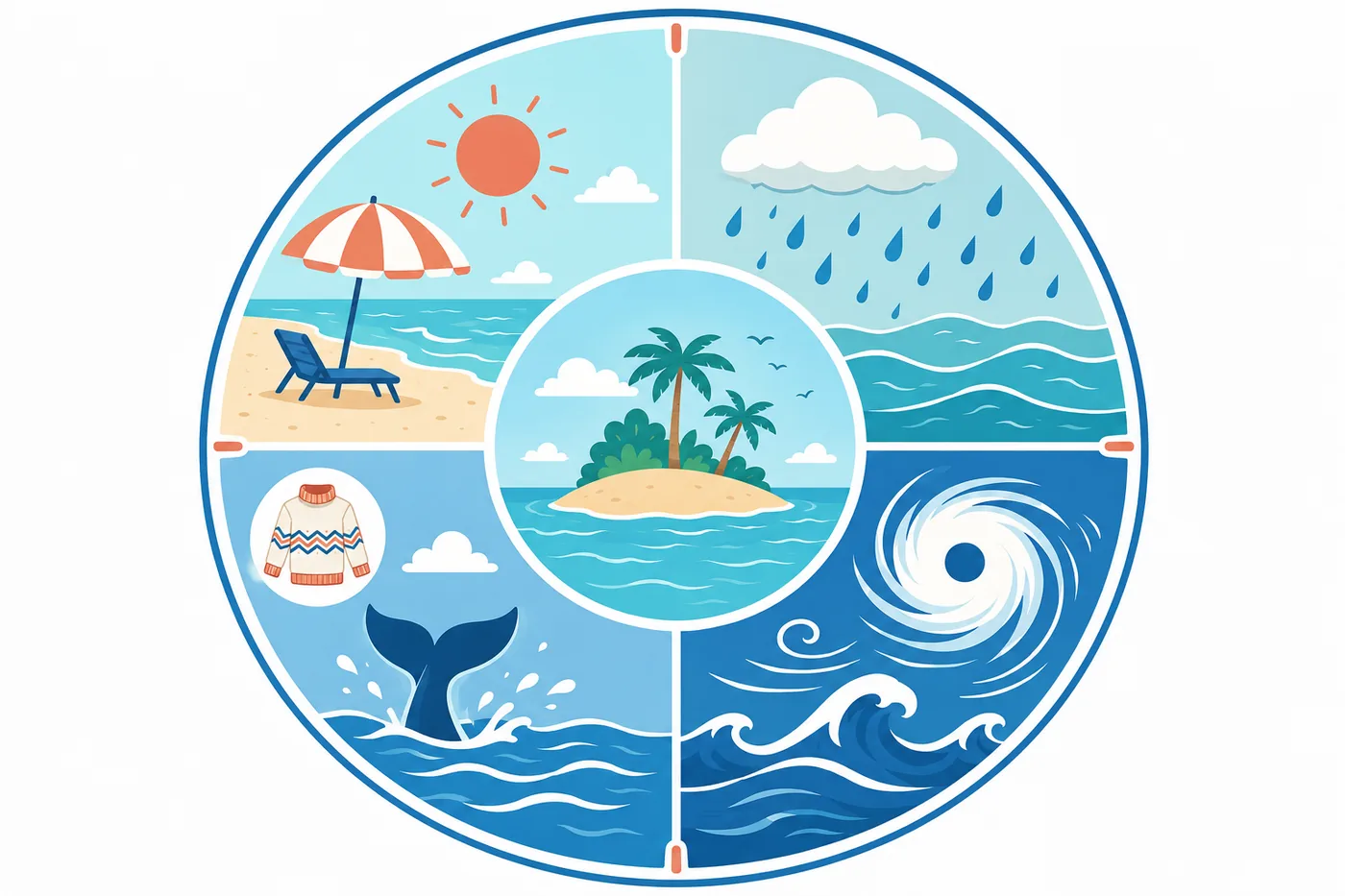
Which season fits which purpose?
Winter: choose variety, not a swimming promise
Winter can suit whale watching, heritage, crafts, food, hiking, and condition-appropriate diving or snorkeling. The official Okinawa guide highlights whale watching in winter and notes that coats or sweaters can sometimes be needed when northerly winds lower perceived temperature. [S3] Some beaches or businesses may have seasonal closures or shorter hours, so verify the exact service.
Spring: check the beach, not only the calendar
Beach-opening events begin at different locations, but an opening date does not determine water comfort or daily safety. Confirm lifeguard coverage, operating hours, warnings, weather, and the needs of children or less experienced swimmers.
Rainy season: keep the itinerary flexible
The Japan Meteorological Agency identifies May–June as Okinawa's rainy season. [S1] Do not treat that as continuous rain or as a dry-weather promise between showers. Use current forecasts and warnings, protect electronics and medication, and hold indoor alternatives.
Summer and early autumn: plan for heat and disruption
Warm water does not remove risk. Check heat, UV exposure, hydration, lightning, waves, currents, and typhoon information. A storm can affect flights and ferries before or after local weather changes; Okinawa Prefecture's crisis plan documents the risk of interrupted island transport and stranded travelers. [S4]
How should you book around weather uncertainty?
Before payment, check:
- the operator's weather and sea-condition cancellation policy;
- refund, rescheduling, and transport-disruption terms;
- the maximum group size and supervision arrangement;
- whether a safer alternative site or non-marine activity is available;
- the last decision time and how the operator will contact you;
- travel insurance exclusions for named activities and weather events.
Before booking: Use the AMP Safety Check Map to review each listed operator’s public notification status, Maru-Yu designation under the Okinawa Prefectural Public Safety Commission program, and participation in AMP’s medical oxygen network. Inclusion on the map is not a guarantee of safety.
Use the latest Japan Meteorological Agency forecast and warning information close to the activity. Climate normals and average water temperatures describe patterns; they do not overrule real-time warnings or a guide's decision to cancel. [S1][S5]
What environmental and capacity rules change by season?
Busy periods can concentrate visitors at accessible sites. Ask the operator how it manages crowding and whether it will change sites or times. In the Kerama region, official ecotourism guidance calls for dispersing use, avoiding repeated concentration at the same point, and following point-specific rest or frequency rules. [S6]
Every season, keep fins and equipment away from coral, do not collect or feed wildlife, carry out waste, and follow beach, park, and community rules. Keramashoto National Park publishes these visitor expectations. [S7]
What safety information should never be seasonal?
Check whether a covered marine-leisure business appears in the current Okinawa Prefectural Police operator information, request a briefing you understand, disclose relevant health conditions, use the specified equipment, and accept cancellation when the plan no longer fits the conditions. An official listing is not a guarantee. [S8]
For an urgent ambulance or fire emergency, JNTO lists 119. For an emergency at sea, the official Okinawa travel guide directs travelers to the Japan Coast Guard at 118. [S9][S10]
FAQ
Can I swim in Okinawa in every month?
This guide does not promise that. Water temperature, wind, waves, beach operation, supervision, and personal cold tolerance vary. Check the exact beach and day.
Which month has the warmest average water in the cited series?
August, at 28.6°C. This is an average published for diving seasonality, not a forecast for every Okinawan site. [S2]
Does rainy season mean it rains all day, every day?
No such conclusion can be drawn from a seasonal pattern. May–June is the usual rainy-season period, but daily conditions require a current forecast and warnings. [S1][S5]
When can typhoons affect Okinawa?
The official visitor guide notes a chance from June through September, while the Japan Meteorological Agency describes greater rainfall during the main late-summer typhoon period. Storms outside a simplified planning window are still possible, so check current official information. [S1][S3]
Is winter unsuitable for all marine activities?
No. Guided activities may operate when conditions, equipment, participant ability, and site choice are appropriate. Winter is not a basis for promising swimming or ignoring northerly winds.
What should I do if a tour is cancelled for conditions?
Use the operator's documented refund, rescheduling, or alternative plan. Do not pressure the guide to proceed or seek an informal substitute that has not explained its safety process.
Sources
- [S1] Japan Meteorological Agency, “Normal weather in Okinawa” (1991–2020 climate normals). Retrieved 18 July 2026. https://www.data.jma.go.jp/cpd/j_climate/okinawa/main.html
- [S2] Okinawa Story / Okinawa Convention & Visitors Bureau, “Diving,” monthly average water-temperature table. Retrieved 18 July 2026. https://www.okinawastory.jp/feature/activity/diving
- [S3] VISIT OKINAWA JAPAN, “When to Visit—Okinawa's Climate & Seasons.” Retrieved 18 July 2026. https://visitokinawajapan.com/plan-your-trip/when-to-visit-climate-seasons/
- [S4] Okinawa Prefecture, Okinawa Tourism Crisis Management Plan. Retrieved 18 July 2026. https://www.pref.okinawa.jp/_res/projects/default_project/_page_/001/011/753/zentai-kankoukikikanri.pdf
- [S5] Japan Meteorological Agency, weather and warning portal. Retrieved 18 July 2026. https://www.jma.go.jp/bosai/
- [S6] Ministry of the Environment, Kerama Region Ecotourism Guidelines. Retrieved 18 July 2026. https://www.env.go.jp/nature/ecotourism/try-ecotourism/certification/kerama/kousou/images/document/guidline.pdf
- [S7] Ministry of the Environment, “Visitor manners in Keramashoto National Park.” Retrieved 18 July 2026. https://www.env.go.jp/nature/nationalparks/list/kerama-shoto/manner/
- [S8] Okinawa Prefectural Police, “Safe leisure at seas and rivers.” Updated 12 June 2026. Retrieved 18 July 2026. https://www.police.pref.okinawa.jp/docs/2015022200039/
- [S9] Japan National Tourism Organization, “Japan Visitor Hotline.” Retrieved 18 July 2026. https://www.japan.travel/en/plan/hotline/
- [S10] VISIT OKINAWA JAPAN, “Beach Information.” Retrieved 18 July 2026. https://visitokinawajapan.com/discover/beach-information/
🇯🇵 日本語 · 🇬🇧 English