
Start by treating Ryukyu culture as a living set of histories, skills, languages, beliefs, and community practices—not as decoration added to a beach trip. UNESCO describes the Gusuku Sites and Related Properties of the Kingdom of Ryukyu as evidence of five centuries of Ryukyuan history from the 12th to the 17th century. Its nine component parts reflect cultural and economic interchange with Southeast Asia, China, Korea, and Japan. [S1]
A useful visit connects a place or practice to a person who can explain it. Choose a guided heritage visit, a beginner karate session, a workshop with a craft practitioner, a performance with context, or a meal that explains court and everyday food traditions.
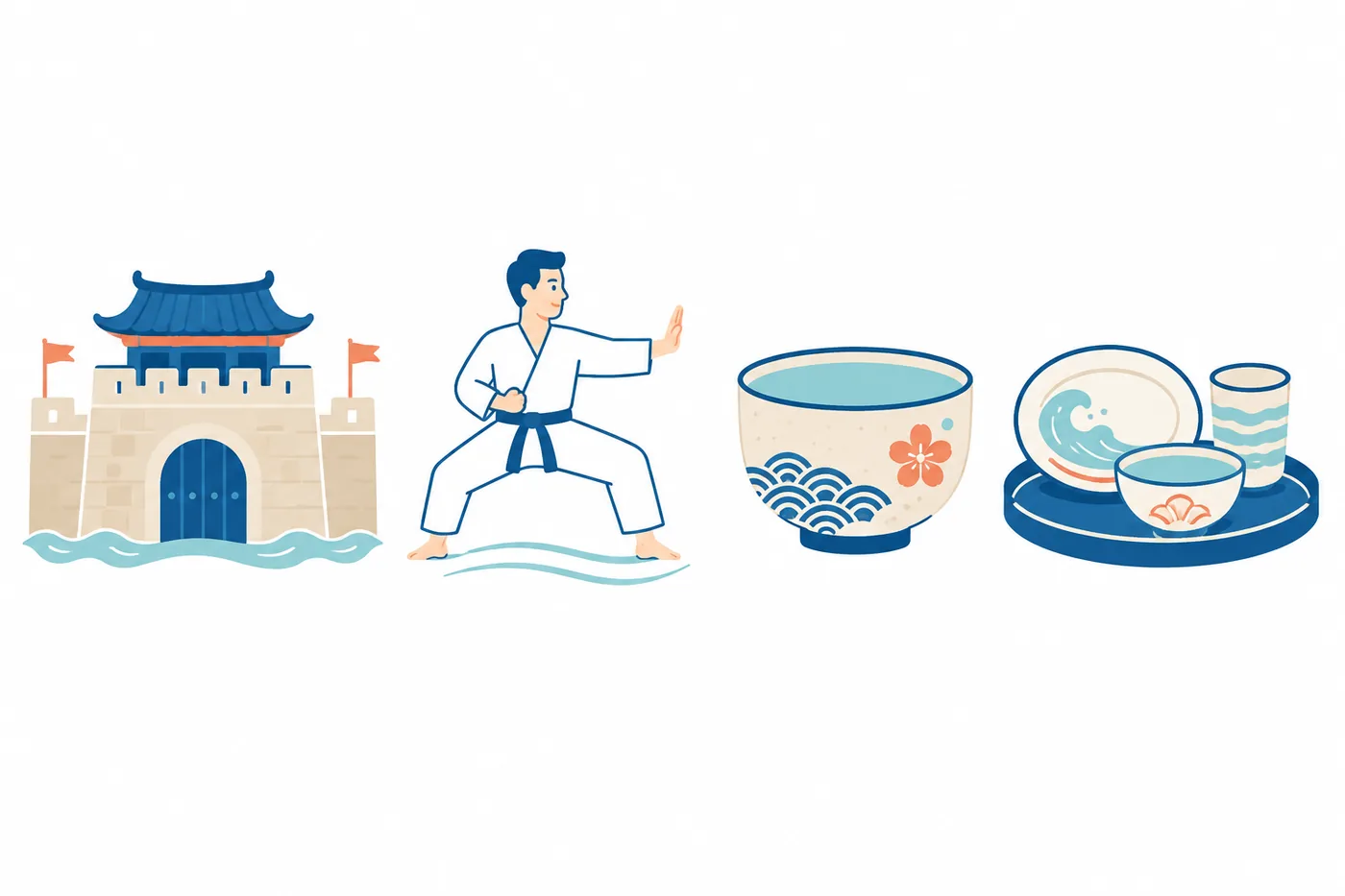
Which hands-on experience fits you?
Learn karate as culture, not a photo pose
Karate originated in Okinawa, and the public Okinawa Karate Kaikan exists to preserve, develop, and communicate that heritage. [S2] A beginner experience should explain etiquette, lineage or school, physical requirements, clothing, and whether observation is possible. Do not enter a dojo, touch equipment, or photograph participants without permission.
Make or study a craft with its maker
Official Okinawa visitor information identifies hands-on options such as bingata dyeing, yachimun pottery, Ryukyu glass, weaving, and sanshin experiences. [S3] Ask who teaches, which stages you will perform, whether the piece is made locally, how long drying or firing takes, and whether shipping is available. A short painting activity and a full making process are different products; the description should say which one you are booking.
Eat Ryukyu cuisine with historical context
Okinawa Prefecture describes traditional Ryukyu cuisine as including both court cuisine and food developed in island households, and it runs preservation and succession programs. [S4] Enjoy the food as cultural knowledge and hospitality. Do not present a meal as a treatment, a route to longevity, or proof of a modern population-wide health outcome.
Visit heritage and sacred places with a guide
The UNESCO property includes five castle sites, two monuments, and two cultural landscapes across Okinawa Island. [S1] Some cultural landscapes and utaki are places of continuing spiritual significance. Follow signs and local instructions, stay on permitted routes, keep voices low where requested, and ask before photography.
Before booking: Use the AMP Safety Check Map to review each listed operator’s public notification status, Maru-Yu designation under the Okinawa Prefectural Public Safety Commission program, and participation in AMP’s medical oxygen network. Inclusion on the map is not a guarantee of safety.
What should a transparent booking page tell you?
Before paying, look for:
- the practitioner, cultural organization, guide, or host responsible for the experience;
- the language and level of interpretation;
- duration, accessibility, physical contact, clothing, and age requirements;
- the maximum group size and whether the session is private or shared;
- what is made, tasted, performed, or taken home;
- photography, recording, and social-media rules;
- price, cancellation terms, and what portion—if stated—goes to the practitioner;
- an alternative plan for severe weather or transport disruption.
If a listing uses “authentic” without identifying the teacher, tradition, method, or community relationship, ask for specifics.
How do season and capacity affect cultural visits?
Indoor craft, food, museum, and dojo experiences can provide alternatives when rain, wind, heat, or marine conditions change a coastal plan. Okinawa's climate includes a May–June rainy season, a period of greater typhoon influence, and winter northerly winds. [S5] Festivals and community events may follow local or traditional calendars; verify the current date and visitor conditions rather than assuming an annual event will repeat unchanged.
Small workshops, kitchens, dojos, heritage sites, and sacred places have different capacity limits. Use the number set by the host or managing authority. Do not add guests, enter closed areas, or pressure a practitioner to shorten a process for a tight itinerary.
What safety and environmental information belongs here?
For a physical session, disclose injuries or health constraints, follow the instructor, and stop if asked. For kilns, dyes, glass, blades, food allergens, or heat, request the specific safety briefing before beginning. For outdoor heritage sites, check footwear, heat, rain, and evacuation information.
Carry out waste and avoid taking plants, stones, coral, or cultural material from protected or community places. In Keramashoto National Park, official visitor guidance explicitly asks visitors to respect utaki and places of worship as local sacred spaces. [S6] Apply the same principle wherever a host or sign identifies a place as sacred.
For an urgent ambulance or fire emergency in Japan, JNTO lists 119 and provides a multilingual visitor hotline for assistance with accidents, illness, and disasters. [S7]
FAQ
Is Ryukyu culture simply a regional version of mainland Japanese culture?
That description is too narrow. UNESCO attributes the culture's distinctive development to the Ryukyu Islands' political history and wide-ranging contacts with Southeast Asia, China, Korea, and Japan. [S1]
Can a first-time visitor take a karate lesson?
Some providers offer introductory experiences, but participation, age, health, clothing, and etiquette rules vary. Confirm the instructor and session details before booking. [S2][S3]
Does eating traditional Okinawan food provide a proven longevity benefit?
This page makes no such claim. Ryukyu cuisine is presented as historical and living food culture, not as medical advice or a promised health outcome. [S4]
May I photograph a sacred site or ceremony?
Only when the managing authority or host permits it. A place being open to visitors does not mean every area, person, object, or ritual may be photographed.
How can I tell whether a craft workshop supports local practice?
Ask who teaches, where materials and products come from, which technique is used, what you will actually make, and how payment reaches the practitioner or organization.
What if severe weather disrupts an outdoor cultural visit?
Follow official warnings and the host's instructions. Use a pre-agreed indoor or rescheduled option; do not enter a closed heritage site.
Sources
- [S1] UNESCO World Heritage Centre, “Gusuku Sites and Related Properties of the Kingdom of Ryukyu,” property 972. Retrieved 18 July 2026. https://whc.unesco.org/en/list/972/
- [S2] Okinawa Karate Kaikan, “History / About.” Retrieved 18 July 2026. https://karatekaikan.jp/pages/history
- [S3] VISIT OKINAWA JAPAN, “10 Must-Try Traditional Okinawan Experiences.” Retrieved 18 July 2026. https://visitokinawajapan.com/travel-inspiration/must-try-traditional-experiences/
- [S4] Okinawa Prefecture, “Preservation, promotion and succession of traditional food culture.” Retrieved 18 July 2026. https://www.pref.okinawa.jp/bunkakoryu/bunkageijutsu/1022485/1009626.html
- [S5] Japan Meteorological Agency, “Normal weather in Okinawa” (1991–2020 climate normals). Retrieved 18 July 2026. https://www.data.jma.go.jp/cpd/j_climate/okinawa/main.html
- [S6] Ministry of the Environment, “Visitor manners in Keramashoto National Park.” Retrieved 18 July 2026. https://www.env.go.jp/nature/nationalparks/list/kerama-shoto/manner/
- [S7] Japan National Tourism Organization, “Japan Visitor Hotline.” Retrieved 18 July 2026. https://www.japan.travel/en/plan/hotline/
🇯🇵 日本語 · 🇬🇧 English