
Keramashoto National Park provides one documented measure of Okinawa's coral diversity: Japan's Ministry of the Environment reports 248 coral species there, representing about 62% of the reef-building coral species confirmed in Japan. These figures apply to the national park; they do not establish that all Okinawan reefs have the same diversity or condition. [S1]
The practical reason to care is simple: a reef visit takes place in a living habitat, not on a replaceable attraction. Visitor behavior, guide practice, site selection, anchoring, weather, and cumulative use all affect whether an experience adds pressure or supports stewardship. Kerama's official ecotourism guidance responds by calling for site rotation, dispersal when boats concentrate, coral-sensitive anchoring, and a clear environmental briefing for participants. [S2]
How can you choose a conservation-minded experience?
Before booking, ask:
- Will the guide explain the site's ecology and local rules before entry?
- What is the maximum group size, and how many guests does each guide supervise?
- How does the operator avoid crowding or repeated pressure on one site?
- Does the boat use an established mooring where available, and how is coral damage avoided if anchoring is necessary?
- What happens if wind, waves, current, visibility, heat, or a warning makes the planned site unsuitable?
- Is there a clearly described conservation activity, contribution, or monitoring partner? If so, where can you verify what the contribution funds?
An environmental fee or “eco” label should be treated as a question to investigate, not proof by itself. Ask for the rule, recipient, use of funds, and reporting method.
Before booking: Use the AMP Safety Check Map to review each listed operator’s public notification status, Maru-Yu designation under the Okinawa Prefectural Public Safety Commission program, and participation in AMP’s medical oxygen network. Inclusion on the map is not a guarantee of safety.
What should you do in the water and on shore?
Follow the site-specific briefing. In Keramashoto National Park, official visitor guidance says not to damage coral, take coral or tropical fish, feed wildlife, introduce non-native species, or leave rubbish. It also asks visitors to check tide times and levels near the shore. [S3]
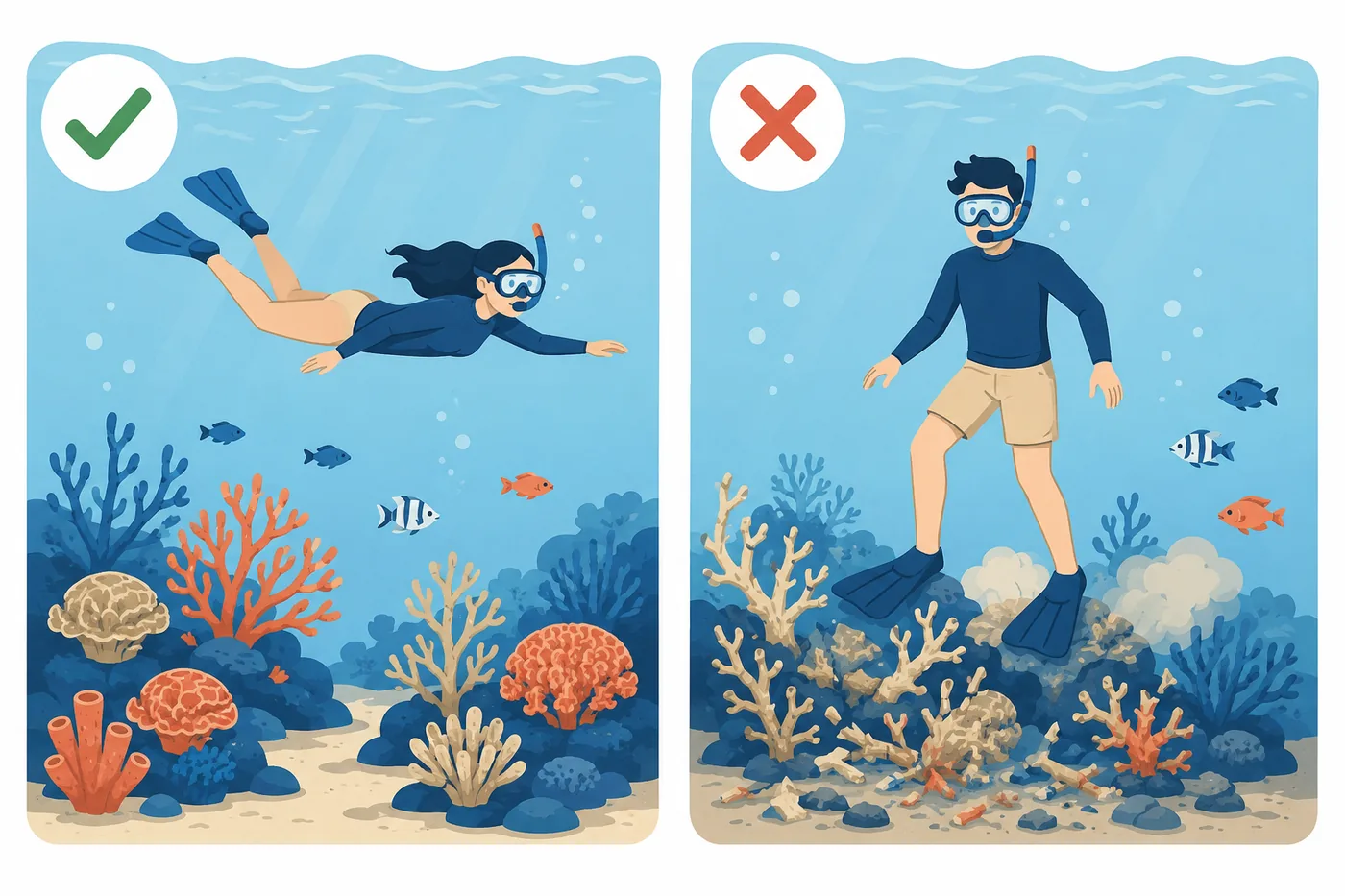
For snorkeling and diving, control buoyancy before approaching the reef, keep fins and equipment away from coral, and never stand on or kick the reef. Kerama's ecotourism rules specifically address fin-caused sediment and standing on coral. [S2] If you cannot maintain control, move to open water and ask the guide for help.
On land, stay within marked or instructed areas, carry waste out, and respect community places as well as natural areas. Some sites include utaki or other places of local worship; the national park asks visitors to show consideration. [S3]
Can a visitor take part in conservation?
Yes, when the activity has a defined method and qualified local lead. Examples may include a guided ecology briefing, approved monitoring, beach litter collection, or a transparent contribution to local management. Participation should not involve touching, moving, planting, or collecting coral unless it is part of an authorized program led by the responsible body.
Ask three questions: Who authorizes the work? What method is used? How are results reported? If those answers are unavailable, enjoy a low-impact guided visit instead of treating an improvised action as conservation.
How do season, weather, and capacity matter?
Okinawa's May–June rainy season and periods of typhoon influence can change visibility, currents, transport, and site access; winter northerly winds can also affect comfort and site choice. [S4] No month removes the need for a day-of-operation decision.
Capacity is site-specific. This draft does not assign a universal number because no single official limit applies to every Okinawan reef. The Kerama guidance instead uses management actions: distribute use, avoid concentrating boats, rotate points, and observe any point-specific frequency or rest rules. [S2] Ask the operator how those principles affect your trip.
What safety information belongs in a reef-conservation page?
Protection of people and protection of reefs are connected. A rushed entry, weak supervision, unsuitable site, or poorly fitted equipment can lead a participant to grab or stand on coral. Choose a notified operator where required, request a briefing you understand, disclose relevant health information, and accept a change or cancellation when conditions are unsuitable. Okinawa Prefectural Police explains the notification framework for covered marine-leisure businesses. [S5]
For an urgent emergency at sea, the official Okinawa travel guide directs travelers to the Japan Coast Guard at 118; for ambulance or fire emergencies, JNTO lists 119. [S6][S7]
FAQ
Are there really 248 coral species throughout Okinawa?
The Ministry of the Environment reports 248 species for Keramashoto National Park. Do not apply that park-specific count to every reef or individual site. [S1]
Is 62% a share of all coral species in the world?
No. The ministry states that the park's 248 species are about 62% of the reef-building coral species confirmed in Japan. [S1]
May I touch coral gently for a photograph?
No. Official park guidance asks visitors not to damage coral, and the local ecotourism rules tell divers and snorkelers not to stand on or kick it. [S2][S3]
Is feeding fish a harmless way to see them closely?
No. Keramashoto National Park's visitor rules say not to feed wild animals. Observe wildlife without changing its behavior. [S3]
Does every “eco-tour” fund conservation?
Not necessarily. Ask who receives any contribution, what activity it supports, and how results can be checked. Before booking, use the AMP Safety Check Map to review public notification status, Maru-Yu designation, and medical oxygen network participation. Inclusion on the map is not a guarantee of safety.
What if the planned reef is crowded?
Ask the operator to use its alternative-site or cancellation plan. Kerama's official guidance calls for dispersal and avoiding concentrated use of the same point. [S2]
Sources
- [S1] Ministry of the Environment, “Features of Keramashoto National Park.” Retrieved 18 July 2026. https://www.env.go.jp/nature/nationalparks/list/kerama-shoto/feature/
- [S2] Ministry of the Environment, Kerama Region Ecotourism Guidelines. Retrieved 18 July 2026. https://www.env.go.jp/nature/ecotourism/try-ecotourism/certification/kerama/kousou/images/document/guidline.pdf
- [S3] Ministry of the Environment, “Visitor manners in Keramashoto National Park.” Retrieved 18 July 2026. https://www.env.go.jp/nature/nationalparks/list/kerama-shoto/manner/
- [S4] Japan Meteorological Agency, “Normal weather in Okinawa” (1991–2020 climate normals). Retrieved 18 July 2026. https://www.data.jma.go.jp/cpd/j_climate/okinawa/main.html
- [S5] Okinawa Prefectural Police, “Safe leisure at seas and rivers.” Updated 12 June 2026. Retrieved 18 July 2026. https://www.police.pref.okinawa.jp/docs/2015022200039/
- [S6] VISIT OKINAWA JAPAN, “Beach Information.” Retrieved 18 July 2026. https://visitokinawajapan.com/discover/beach-information/
- [S7] Japan National Tourism Organization, “Japan Visitor Hotline.” Retrieved 18 July 2026. https://www.japan.travel/en/plan/hotline/
🇯🇵 日本語 · 🇬🇧 English