
You cannot remove all risk from snorkeling, diving, kayaking, or other ocean activities. You can, however, choose an operator that makes its safety decisions visible. In Okinawa, certain marine-leisure businesses must notify the Prefectural Public Safety Commission before operating, and the Okinawa Prefectural Police publishes operator information. A listing is a useful check, but it is not a promise that an accident cannot happen. [S1]
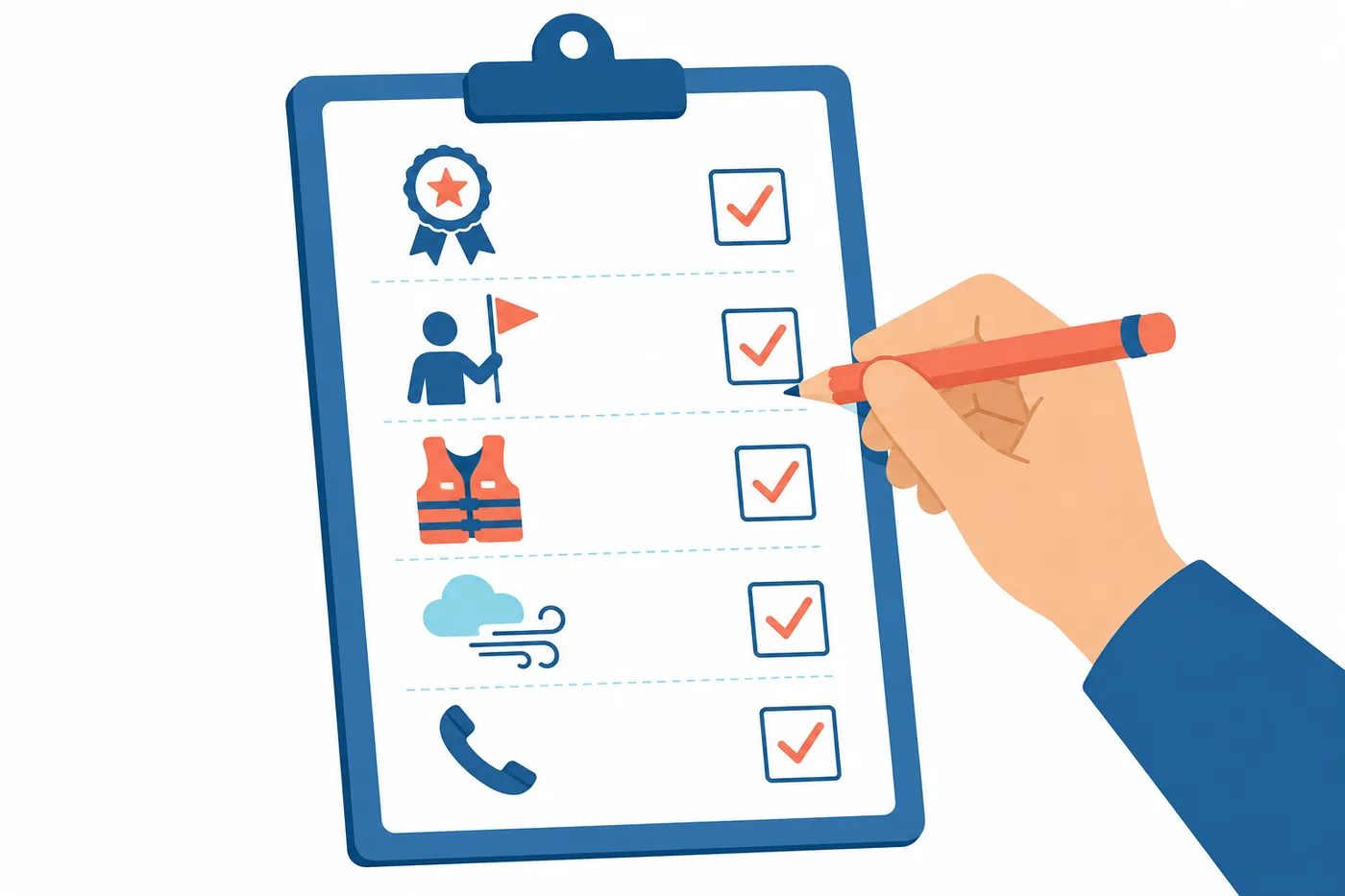
What should you check before booking?
Ask the operator for clear answers to these questions:
- Is the business listed as a notified operator for this activity? Check the current official list rather than relying on a logo or an unsourced claim. [S1]
- Who leads the activity? Ask about the guide's relevant training, the language used for the briefing, the maximum number of guests per guide, and how children or first-time participants are supervised.
- What equipment is included? Confirm flotation equipment where appropriate, exposure protection, communication equipment, first-aid supplies, and emergency oxygen for diving-related activities. Ask how fit and condition are checked.
- What conditions trigger a change or cancellation? A trustworthy answer should cover wind, waves, currents, visibility, lightning, and the abilities of the group. Okinawa has a rainy season and periods when typhoons may affect travel, so a fixed itinerary should never override conditions on the day. [S2]
- What is the emergency plan? Ask who stops the activity, who contacts emergency services, how the group is counted, where evacuation begins, and how long it may take to reach appropriate care from the actual site.
- What does the price and insurance cover? Request written information about inclusions, exclusions, cancellation terms, participant insurance, and any limits. Do not assume that travel insurance covers every marine activity.
- What health information must you disclose? Answer screening questions honestly. If the operator asks you to obtain medical clearance, do so before arriving.
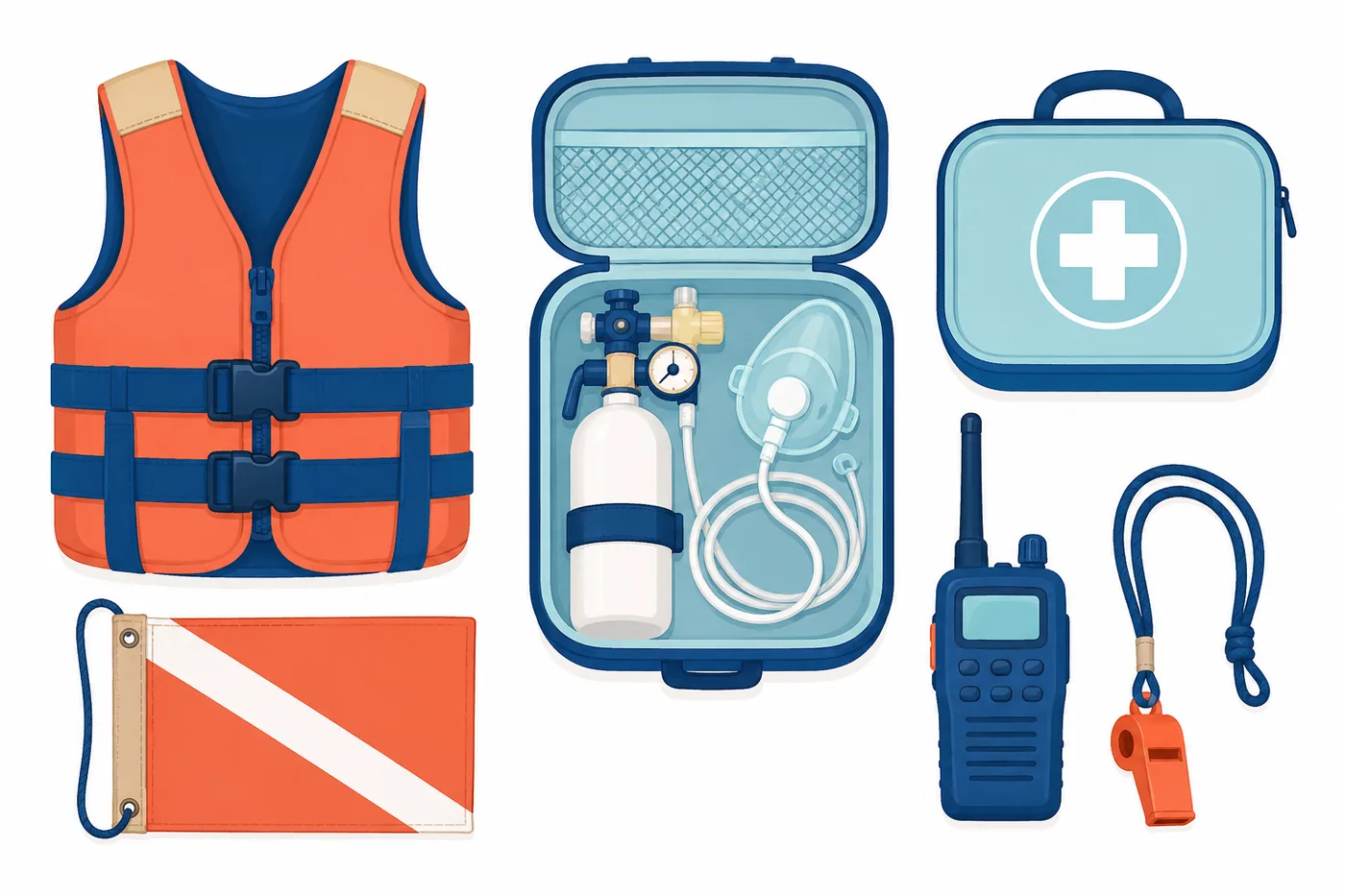
Before booking: Use the AMP Safety Check Map to review each listed operator’s public notification status, Maru-Yu designation under the Okinawa Prefectural Public Safety Commission program, and participation in AMP’s medical oxygen network. Inclusion on the map is not a guarantee of safety.
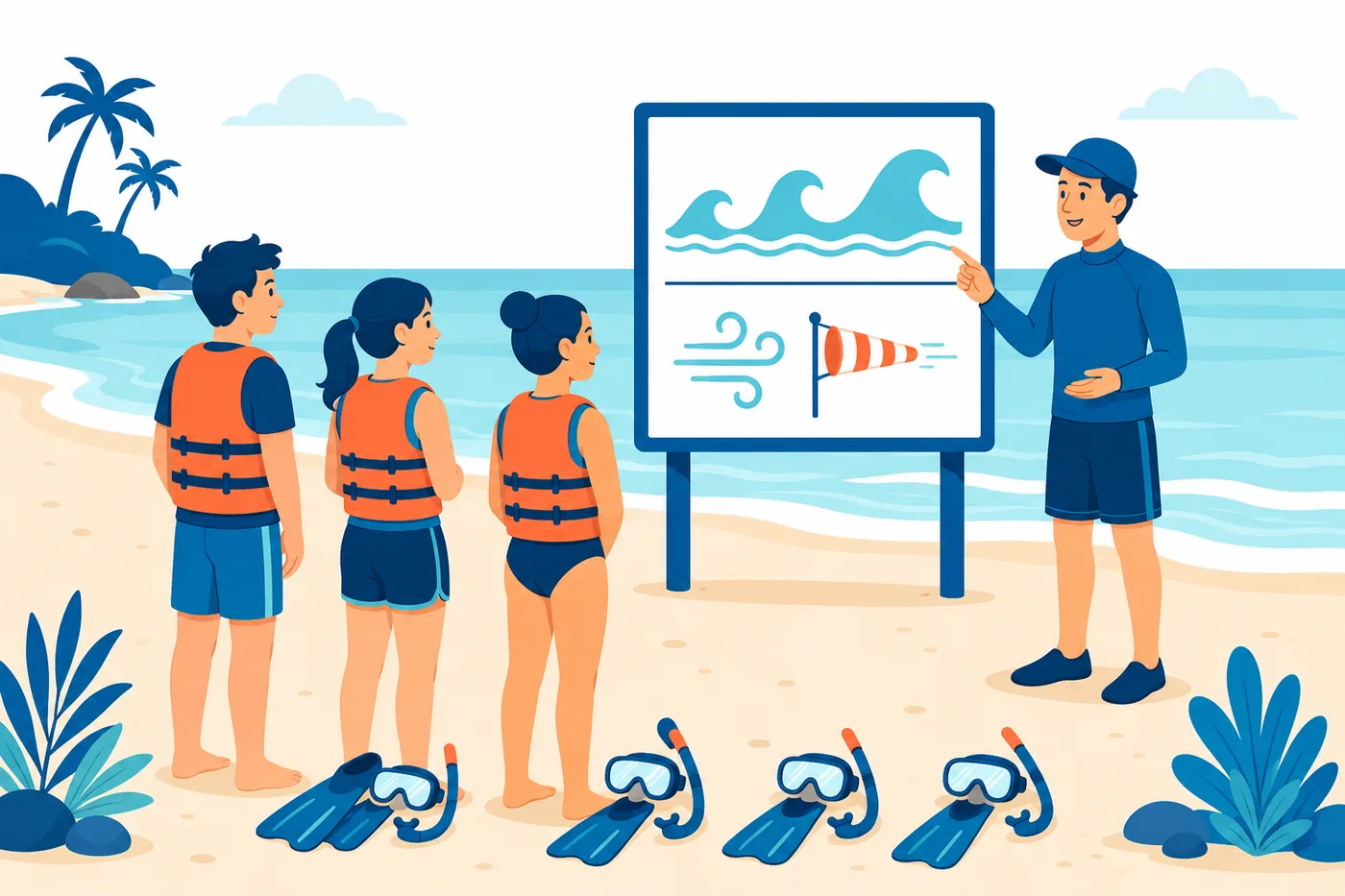
What should the pre-activity briefing include?
The briefing should identify the day's site and conditions, boundaries, buddy or group procedure, hand signals, entry and exit method, wildlife and coral rules, lost-person procedure, and the point at which a participant should stop. It should also explain how the plan changes for a child, a non-swimmer, a first-time snorkeler, or a diver with limited recent experience.
If you do not understand the briefing, ask for it again in a language or format you can follow. Declining an activity when the explanation or conditions are not right is a valid safety decision.
What happens in an emergency?
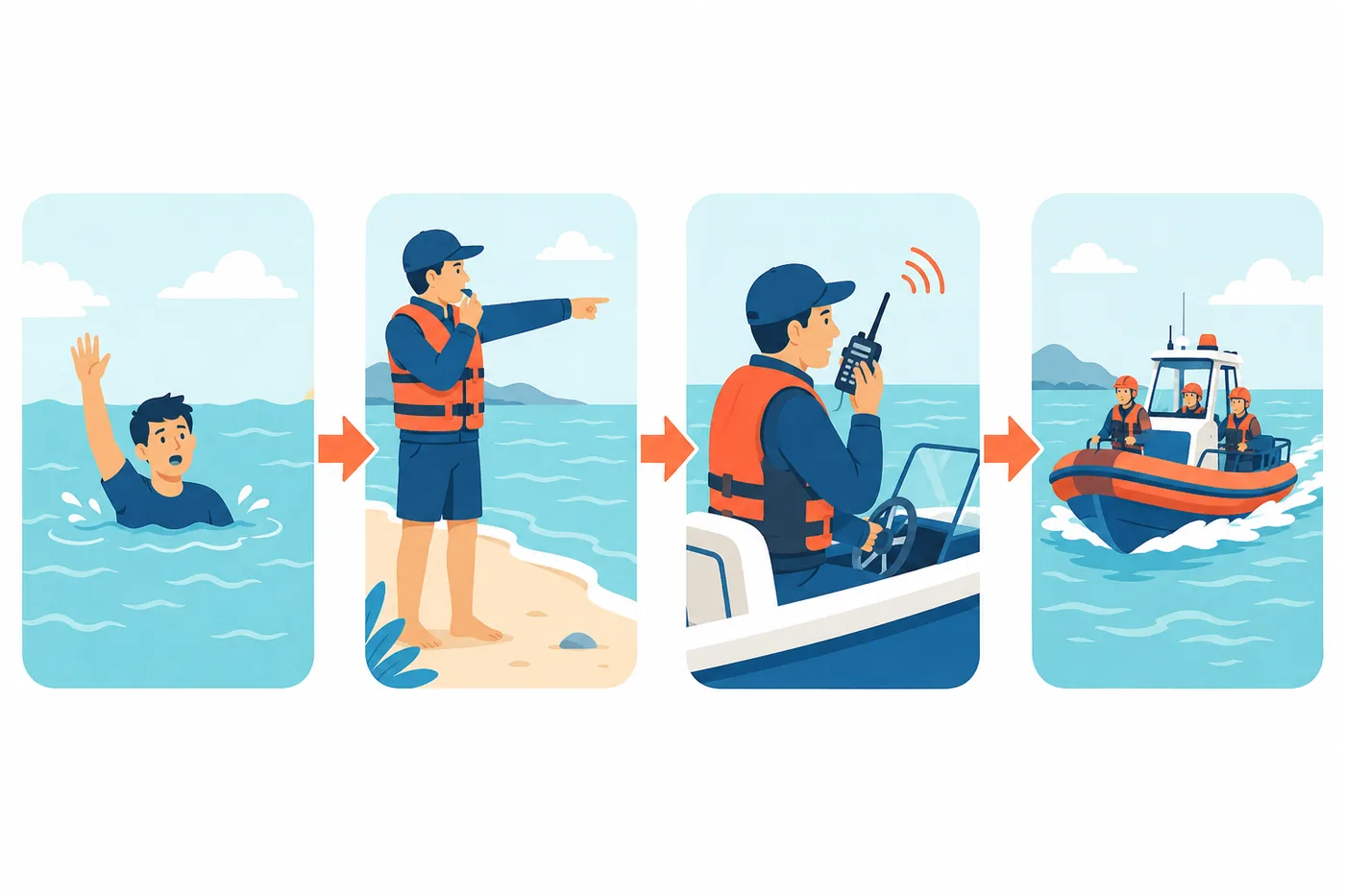
The exact response depends on the activity and location, but the traveler-facing sequence should be simple:
- Stop the activity and alert the guide, lifeguard, or boat crew.
- Follow the leader's instructions and keep the rest of the group accounted for.
- Contact the relevant emergency service and give the location, activity, number of people involved, and known condition. Japan's urgent ambulance/fire number is 119; the official Okinawa travel guide directs sea emergencies to the Japan Coast Guard at 118. [S3][S4]
- Provide first aid only within your training and use the operator's emergency equipment as directed.
- For a suspected diving-related injury, seek urgent professional assessment. The University of the Ryukyus Hospital has a hyperbaric treatment department that includes decompression illness among the conditions it treats, but its existence does not mean that every island or reef has immediate access. [S5]
- Follow medical and transport instructions. Do not make onward-flight decisions from a travel article.
JNTO also operates a multilingual visitor hotline for accident, illness, and disaster assistance. It is a support channel, not a substitute for urgent emergency services. [S3]
How do season and location change the decision?
Okinawa is warm relative to much of Japan, but conditions are not uniform. The Japan Meteorological Agency describes higher rainfall during the May–June rainy season and during the main late-summer typhoon period, while winter can bring more cloud, rain, and northerly winds. [S2] Check the forecast, warning information, beach status, ferry or flight status, and operator update shortly before departure.
Remote-island access may depend on air or sea transport. Okinawa Prefecture's tourism crisis plan notes that storms can interrupt movement and create stranded travelers. [S6] Build time into the itinerary and ask what happens if the outbound or return service is cancelled.
What capacity and reef rules should you ask about?
Ask for the operator's maximum group size, guide-to-guest arrangement, and site-use policy. A responsible plan should be willing to move or cancel when a site is crowded or conditions deteriorate. In Keramashoto National Park, official ecotourism guidance calls for dispersing use across sites and avoiding concentrated repeat use; visitors are also asked not to damage or collect coral or wildlife. [S7][S8]
FAQ
Is an officially listed operator risk-free?
No. Official notification status is a meaningful verification step, not a guarantee. You still need to assess the activity, conditions, guide plan, equipment, and your own health and ability. [S1]
Can a beginner join any snorkeling tour?
No. Suitability depends on the site, conditions, supervision, swimming comfort, health, and the operator's participation rules. Ask how beginners and non-swimmers are managed before paying.
Should a tour continue if the weather looks calm at the hotel?
Not automatically. Conditions at the activity site can differ, and wind, waves, current, visibility, warnings, and transport disruption all matter. The operator should make and explain the site-specific decision.
What numbers should I know for an urgent incident?
For an ambulance or fire emergency in Japan, call 119. For an emergency at sea, the official Okinawa guide directs travelers to the Japan Coast Guard at 118. [S3][S4]
Does Okinawa have treatment for decompression illness?
The University of the Ryukyus Hospital operates a hyperbaric treatment department that treats decompression illness. Access time and transport differ by location, so this should not be interpreted as immediate coverage for every dive site. [S5]
What if the operator cannot explain its cancellation or emergency policy?
Choose another activity or operator. Transparent limits and a clear stop plan are part of making an informed decision.
Sources
- [S1] Okinawa Prefectural Police, “Safe leisure at seas and rivers,” including notification requirements and links to operator lists. Updated 12 June 2026. Retrieved 18 July 2026. https://www.police.pref.okinawa.jp/docs/2015022200039/
- [S2] Japan Meteorological Agency, “Normal weather in Okinawa” (1991–2020 climate normals). Retrieved 18 July 2026. https://www.data.jma.go.jp/cpd/j_climate/okinawa/main.html
- [S3] Japan National Tourism Organization, “Japan Visitor Hotline,” including 119 and multilingual assistance. Retrieved 18 July 2026. https://www.japan.travel/en/plan/hotline/
- [S4] VISIT OKINAWA JAPAN, “Beach Information,” including 118 for emergencies at sea. Retrieved 18 July 2026. https://visitokinawajapan.com/discover/beach-information/
- [S5] University of the Ryukyus Hospital, Hyperbaric Treatment Department. Retrieved 18 July 2026. https://www.hosp.u-ryukyu.ac.jp/departments/koukiatu.html
- [S6] Okinawa Prefecture, Okinawa Tourism Crisis Management Plan. Retrieved 18 July 2026. https://www.pref.okinawa.jp/_res/projects/default_project/_page_/001/011/753/zentai-kankoukikikanri.pdf
- [S7] Ministry of the Environment, Kerama Region Ecotourism Guidelines. Retrieved 18 July 2026. https://www.env.go.jp/nature/ecotourism/try-ecotourism/certification/kerama/kousou/images/document/guidline.pdf
- [S8] Ministry of the Environment, “Visitor manners in Keramashoto National Park.” Retrieved 18 July 2026. https://www.env.go.jp/nature/nationalparks/list/kerama-shoto/manner/
🇯🇵 日本語 · 🇬🇧 English